
How to Check Tire Pressure: A Step-By-Step Guide for Safe, Properly Inflated Tires
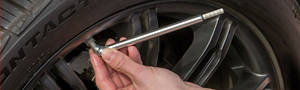
A properly inflated tire is a safe tire. Learning how to check your tire pressure regularly is an important aspect of vehicle ownership. Discount Tire shows you how!
Need your tires inspected, including the air pressure? At Discount Tire, Tire Inspection is a free service.
Schedule an AppointmentWHY PROPER TIRE PRESSURE MATTERS
The correct air pressure is paramount to both the safety and performance of your tires. The proper psi helps with:
Road safety
Improved performance such as handling, cornering, steering, and stability
Optimized tire performance
The right air pressure is especially important when towing.
Tools to check your tires' air pressure
To check your tire pressure, you'll only need a dependable tire pressure gauge. However, if your tires are low on air, you'll need access to an air compressor to get them inflated to the proper pressure. Next, we'll walk you through all the steps.
HOW TO CHECK TIRE PRESSURE: STEP-BY-STEP
Check your tires before driving for the most accurate reading. Driving heats the air within a tire, causing the air to expand and give a higher pressure reading. If you do need to check the air pressure after driving, subtract 3 psi from the gauge reading to account for the temperature difference.
Here's a breakdown breakdown for airing up your tires:
1. Find your vehicle’s recommended tire pressure
Your tires should be inflated to the air pressure recommended by your vehicle’s manufacturer. In most vehicles, you can find this info on the tire placard, a sticker with vehicle information that is typically on the inside edge of your driver’s side door frame. If it’s not there, check your vehicle owner’s manual.
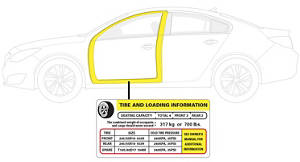
The manufacturer lists the tire pressure in psi (pounds per square inch). It may list different pressures for front and rear tires.
IMPORTANT: You should not inflate a tire to the maximum inflation pressure (found on the tire's sidewall), as it may list a different pressure than what is recommended by the vehicle manufacturer.
2. Inspect and remove valve cap
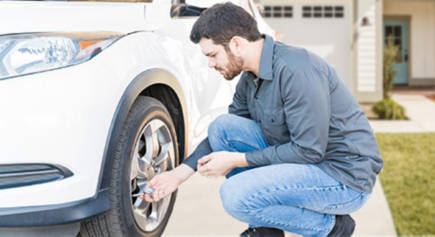
Remove and inspect the valve cap, specifically for cracks.
The valve cap protects the opening at the end of the valve stem, a small tube that controls airflow in and out of the tire. It helps prevent air loss.
Most valve caps have a rubber grommet inside the cap to create a tight seal. If it’s cracked or missing, replace it as soon as possible.
3. Use the air gauge to get an accurate reading
Check your pressure:
Firmly place the gauge’s exposed end onto the valve stem. If you hear a hissing sound after you place it on the stem, it is not centered correctly.
Adjust until there is no hissing and get the reading. Compare it to the vehicle’s recommended pressure to see if you need to add or remove air.
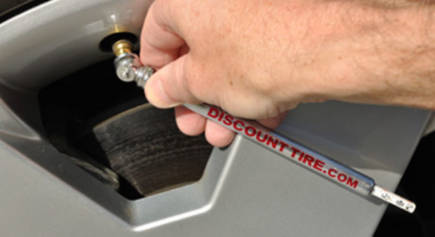
A quality air gauge will consistently provide correct readings. We recommend keeping one in your vehicle. Gas stations, car washes, and other public gauges are notoriously inaccurate due to age, exposure, or abuse.
There are a variety of gauge styles including pencil type gauges, gauges with a meter, and even battery-powered digital models.
4. Adjust your tire pressure & replace valve cap
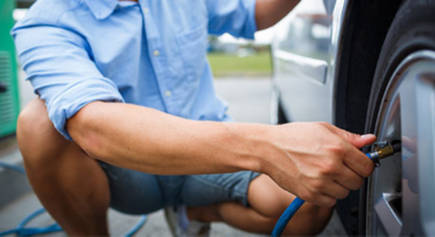
Use a compressor (either your own portable one or a publicly available one) to add air if necessary.
Push the nozzle of the air hose on your valve stem. Make sure there’s no hissing.
Turn on the compressor and add the necessary amount (most compressors have meters to monitor psi).
If you need to remove excess air (overinflated), just depress the small brass needle in the valve stem to let out air. Most air pressure gauges have a protruding area that is the reverse of the exposed valve end (the brass needle) to make deflation easy.
There are rapid tire deflator tools, preset tire deflators, and expensive multi-tire inflation systems that off-road enthusiasts use to rapidly deflate their tires for off-road purposes. This is called airing down.
NOTE: Just like public air gauges, public air compressors are often neglected or abused so they may not work well.
TIRE PRESSURE FAQs & TIPS
Here’s some more tips and answers about checking your tire pressure:
Invest in an accurate air gauge and keep it in your vehicle. Service station air meters are often inaccurate due to abuse or environmental exposure. Don’t assume you can just look at your tires and guess the tire pressure.
Fill your tires slowly and evenly to avoid overinflation. Slow down when you get close to the psi level you want. Using an air hose, fill your tires slowly and evenly to avoid overinflation.
Always replace your valve stem caps after refilling your tires. Despite their small size, these caps perform an important function. They keep your valve stems safe and clean, preventing air leakage as you drive.
Check your tire pressure after any sharp increase or decrease in temperature.
Develop and stick to a routine for checking your air pressure. Remember to also check your spare tire so you're not caught with an unusable or unsafe spare in an emergency.
What is the recommended tire pressure for my car?
You can find the recommended tire pressure for your vehicle on your tire placard, located on the inside of your driver’s side door frame. If it’s not there, you can check your owner’s manual.
The recommended tire pressure IS NOT the same as the maximum tire pressure listed on your tire’s sidewall.
How often should I check my tire pressure?
We recommend checking your tire air pressure every time you fill your gas tank. It’s best to get into a routine because tire pressure affects so many aspects of tire life, safety, and performance.
Many drivers feel they can ignore their tires because their vehicles are equipped with a Tire Pressure Monitoring System (TPMS). However, TPMS only alerts once tires are 25% below their proper air pressure and negative effects of underinflation can be seen as soon as 5%.
Can I rely on gas station tire gauges?
If you can, you should invest in your own tire gauge because gas station gauges are unreliable. You can pick up an inexpensive gauge for a few dollars at any hardware or auto store.
Why is my tire slowly losing air?
There are many reasons your tire might be slowly leaking air, including:
Damaged or worn valve stem
Aging/old tires (tires become more brittle as they age)
Bead leak (leaking from the rim)
Temperature changes (for every 10F change in temperature, tires can lose or add approximately 1 psi)
Damage, such as a puncture or lodged object
DISCOUNT TIRE OFFERS FREE AIR CHECKS
Having trouble or need assistance? No problem, we offer free air checks! Drop by your local Discount Tire store and take advantage of our complimentary tire inflation service, which includes a free tire inspection.
If your tires are consistently losing air, they may need repair or replacement. You can make an appointment with us for repair and replacement to save some time! If you need new tires, we can help you find the right new tire for you. Using Treadwell, our intuitive tire buyer's guide, you can input your driving style, conditions, make and model of your car and so on to analyze the best tire option for you.
Get a shorter wait time in-store when you buy and book online!