
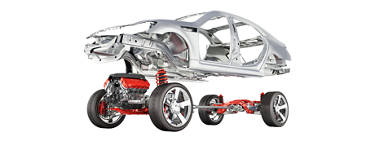
If you hear the word "drivetrain" and your mind goes blank, you're not alone.
A vehicle's drivetrain sounds technical, and it is, but the idea is pretty simple. More importantly, your drivetrain plays a direct role in how your vehicle handles, how your tires wear, and how confident you feel on the road.
We break it down in plain terms below.
What Is a Drivetrain?
A drivetrain is the group of components that transfers power from your engine to your wheels.
You've probably heard of rear-wheel drive, all-wheel drive, and four-wheel drive. That's your drivetrain.
Your vehicle's drivetrain is the middleman between your engine and your wheels. Your wheels cannot operate until they receive power from the engine.
What Does a Drivetrain Do in a Car or Truck?
Your drivetrain turns engine power into motion. Without it, your engine could run but your vehicle wouldn't go anywhere.
Here's what it does:
- Transfers power from the engine to the wheels
- Adjusts speed and torque as you drive
- Helps your vehicle accelerate, turn, and maintain control
The drivetrain is what connects everything and makes movement possible.
It may be helpful to picture a bicycle:
- Your legs = the engine
- The chain and gears = the drivetrain
- The wheels = what actually move you forward
What Parts Make Up a Drivetrain?
Your drivetrain is made up of several key components that work together behind the scenes:
Transmission
A set of gears that takes power generated from your engine and sends it through the driveshaft to the axles. Vehicles can be manual transmission, where you shift the gears yourself, or automatic.
Driveshaft
This connects the transmission to the differential and/or the axles depending on vehicle type. Not all vehicles have a driveshaft. Sometimes it is called a propeller shaft.
Differential
This turns driveshaft rotation into forward motion. It also allows your wheels to rotate at different speeds during turns. This directly affects your tires.
Axles
This connects the differential directly to your wheels. It is the last piece of drivetrain power flow so your vehicle can move.
Different Types of Drivetrain Systems
Not all vehicles deliver power the same way. Your drivetrain type affects how your vehicle handles and how your tires perform.
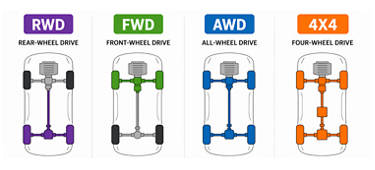
Rear-Wheel Drive (RWD)
- Power goes to the rear wheels
- Often found on trucks and performance vehicles
- Known for balanced handling due to weight distribution
- Rear tires handle acceleration forces
- Rear tires tend to wear faster
Front-Wheel Drive (FWD)
- Power goes to the front wheels
- Common in passenger cars and crossovers
- Typically offers good fuel efficiency
- Front tires tend to wear faster
All-Wheel Drive (AWD)
- Sends the appropriate level of power to all four tires
- Automatic and always enabled for consistent performance
- Common in SUVs, crossovers, and performance sedans
- Increasingly common in newer vehicle models
- Offers good performance for wet or slippery paved surfaces
- Not ideal for deep snow
- Requires consistent tire maintenance to avoid uneven treadwear
Four-Wheel Drive (4WD)
- Delivers equal power to all four wheels
- Often must be manually enabled, unlike AWD
- Common in SUVs and pickup trucks
- Ideal for rough terrain, deep snow, and extreme conditions
- Added weight can cause increased tire wear
- Requires regular tire maintenance
- Replacement tires should all be the same size, brand, and tread depth
Want to learn more about how drivetrain affects traction? Check out: What Wheel Drive Is Best in Snow.
Drivetrain vs. Powertrain: What's the Difference?
These terms are often used interchangeably, but they're not the same.
- Powertrain = engine + drivetrain
- Drivetrain = everything that moves power from the engine to your wheels
Your powertrain is the combined group of components that propels your vehicle forward, consisting of your engine and drivetrain.
How Drivetrain Affects Your Tires
Your drivetrain has a big impact on your tires.
Here's how:
- Power distribution affects tire wear: Different drivetrain types put stress on different tires.
- Traction depends on how power is delivered: Some drivetrains perform better in challenging conditions. For example, AWD and 4WD perform better in winter conditions.
- Uneven power flow can cause uneven wear: Can happen especially if components aren't working properly.
- Tire rotation becomes more important: Regular rotations help balance wear across all four tires. Rotation placement will also depend on the drivetrain. For example, FWD vehicles wear tires faster in front.
Signs of Drivetrain Issues
Drivetrain issues can affect both performance and safety.
Watch for these warning signs:
- Vibrations while driving
- Clunking or knocking noises
- Difficulty turning, shifting, or handling
- Fluid leaks under your vehicle
- Hesitation or loss of power
- Warning lights, including check engine or transmission warnings
If something feels off, you should have your vehicle inspected.
Why the Drivetrain Matters
Your drivetrain is what moves your vehicle, playing a major role in how your vehicle feels and performs on the road.
It impacts:
- Safety: Proper power delivery helps maintain control
- Performance: Smooth acceleration and handling
- Efficiency: A well-functioning system reduces strain
- Tire wear: Power distribution affects how tires wear over time
The Bottom Line
Your drivetrain is what turns engine power into forward motion. Although it's unseen, it's working every time you press the gas pedal.
Understanding how it works can help you:
- Recognize potential issues early
- Make informed vehicle decisions
- Get the most out of your tires and driving experience
Need Help With Your Tires?
If something doesn't feel quite right or your tires aren't wearing evenly, it could be related to your powertrain.
Stop in to your nearest Discount Tire for a free tire inspection and we'll ensure there's nothing wrong with your tires or wheels. Our tire experts are trained to recognize these issues.
If the problem isn't your tires, we can point you in the direction of a good auto service shop nearby.
Ready to roll?
If you have any questions or are unsure what tires work best for you, drop in or give us a ring. We’ll get you taken care of.Buy and book online and save time in-store!
Schedule An AppointmentFAQ
A drivetrain is the system of components that transfer power from your engine to your wheels. It’s what allows your vehicle to move.
The drivetrain delivers power from the engine to the wheels, helping your vehicle accelerate, maintain speed, and handle different driving conditions.
A drivetrain typically includes the transmission, driveshaft, differential, and axles. Some vehicles may not have a driveshaft. These parts work together to move power from the engine to the wheels.
No, the transmission is just one part of the drivetrain. The drivetrain includes multiple components that work together to deliver power to the wheels.
The powertrain includes both the engine and the drivetrain. The drivetrain only includes the parts that move power after it leaves the engine.
Yes, the way power is delivered to your wheels can affect how your tires wear. For example, FWD (front-wheel drive) vehicles often wear front tires faster.
If the drivetrain fails, your vehicle may lose the ability to move properly. You might notice vibrations, unusual noises, or handling issues, and the vehicle may not drive safely.