
Watch to learn more
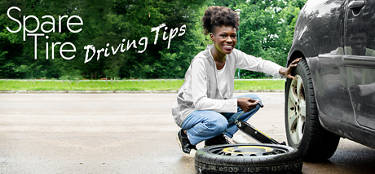
Spare Tire Driving Tips:
Driving on a spare tire is a temporary solution, not a long-term fix. Most temporary spare tires, often called donuts, follow the 50/50 rule: no more than 50 mph and no more than 50 miles. Exceeding these limits can damage your vehicle or cause tire failure.
There are two kinds of spare tires: a temporary donut spare and a full-size spare. The donut spare is smaller than your regular tire and is meant to be driven only to the next service station. It is not meant to replace your damaged full-size tire long term. A full-size spare can usually be used like an ordinary tire because it is one.
HOW TO CHANGE A TIREHOW FAST CAN YOU DRIVE ON A SPARE TIRE?
Most temporary spare tires are rated for a maximum speed of 50 mph. You can check the sidewall of your spare for the exact speed rating.
Driving faster increases heat buildup and can cause the tire to fail. Because spare tires have smaller diameters than regular tires, they spin and build up heat much faster.
Temporary spare tires do not have much tread because they are intended to bring you to the closest service station.
HOW FAR CAN YOU DRIVE ON A SPARE TIRE?
You should drive no more than 50 miles on a temporary spare tire.
This should be enough to get you to a repair shop. Driving farther risks tire breakdown and damage to your drivetrain.
Also, keep an eye on your spare tire’s health. They are susceptible to temperature fluctuations, dry rot, slow air loss and aging just like regular tires.
WHAT IS THE 50/50 RULE FOR SPARE TIRES?
The 50/50 rule for spare tires means a max speed of 50 mph and a max distance of 50 miles.
This applies to most compact spare tires, also called donuts. Full-size spares are like regular tires and typically do not have unusual limitations.
WHAT HAPPENS IF YOU DRIVE TOO FAST OR TOO FAR ON A SPARE TIRE?
Driving too far or too fast on a temporary spare can lead to:
- Tire blowouts due to overheating
- Transmission or differential damage
- Reduced braking and handling control
Temporary spare tires are smaller, have less tread, and rotate faster than regular-size tires, so they put more strain on your vehicle and its components. They also heat up faster.
ARE SPARE TIRES UNIVERSAL?
No, spare tires are not universal.
Each vehicle has a specific:
The wrong spare tire may not fit or can even cause serious damage or unsafe driving conditions.
CAN YOU DRIVE NORMALLY ON A FULL-SIZE SPARE?
Yes, if you have a full-size spare tire then you can usually drive normally.
However, you need to make sure you:
- Match tire pressure and size to the other tires
- Get an inspection to ensure proper alignment and balance
Some drivers will purchase an inexpensive full-size spare, new or second-hand, until they can afford a new set of the same tire brand and model as replacement. We explain more in our guide to mixing tires.
CAN YOU DRIVE ON THE HIGHWAY WITH A SPARE TIRE?
It’s not recommended to drive a temporary spare tire on the highway.
However, if you must due to circumstances, then:
- Stay in the right lane
- Keep speeds under 50 mph
- Put on your hazard lights to alert other drivers
- Exit as soon as possible
WHAT DOES DRIVING ON A SPARE TIRE FEEL LIKE?
You may notice changes in handling while using a temporary spare, including:
- Vehicle pulling to one side
- Longer stopping distances
- Reduced traction, especially in wet conditions
Drive cautiously and avoid sudden movements.
You may not notice these issues when using a full-size spare.
HOW MUCH AIR SHOULD BE IN A SPARE TIRE?
Most temporary spare tires usually require around 60 psi, which is much higher than standard tires. You can check the recommended air pressure on your door jamb sticker or in your owner’s manual.
Check your spare tire regularly. Many go flat in storage or are too old to be used.
HOW LONG DO SPARE TIRES LAST?
Even unused, spare tires degrade over time like regular tires.
Replace your spare tire after 6-10 years. You can check the DOT code on the sidewall for the tire’s age.
DO ALL CARS HAVE SPARE TIRES?
No, many newer vehicles, including some EVs, do not include a spare tire. This is to save on space and weight to increase efficiency.
Alternatives include:
- Run-flat tires
- Tire repair kits
- Roadside assistance membership
WHAT SHOULD YOU DO AFTER INSTALLING A SPARE TIRE?
Once you install a temporary spare tire, you should:
- Immediately drive to a tire repair shop
- Drive safely within 50/50 limits, under 50 mph for 50 miles
- Repair or replace the damaged tire
- Reinflate and store the spare properly
Need a tire repair or replacement?
Have an emergency on your hands? Visit your nearest Discount Tire for fast, safe service. If you need a tire repair or a full replacement, we’re ready to get you taken care of. Buy and book online and save time in-store!
Stay up to date with Discount Tire content: add us as a Preferred Source in Google Search.
For more information on this and other tire and wheel services, check out ourYouTube Channel or reach out to us on X, Instagram, Facebook, TikTok and LinkedIn.