
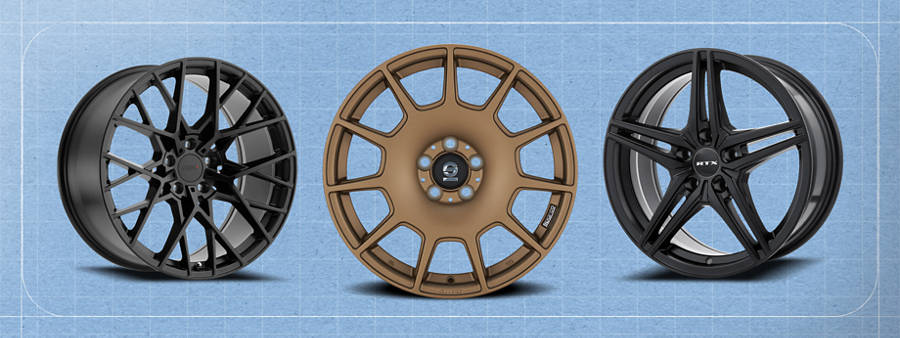
Quick Answer
The best wheel for you depends on your vehicle, your needs, and your budget. Cast wheels are made by pouring molten metal into a mold and cooled into shape. It’s best for everyday driving and is the most affordable, but also the most limited in design options. Forged wheels are created by shaping a solid billet of aluminum under extreme heat and pressure. They offer the best density and lightest weight but can be expensive. Flow-formed wheels are made with a low-pressure casting process while spinning on a specialized machine. They offer a strong, lightweight option that’s cheaper than forged wheels.
AT A GLANCE COMPARISON
All wheels are not made the same way. There are three major wheel construction types: cast, flow-formed, and forged. Each has its own benefits and drawbacks so it’s important to consider which is best for you and your vehicle.
| Cast vs Flow-Formed vs Forged Wheels | |||
|---|---|---|---|
| Feature | Cast | Flow-Formed | Forged |
| Best for | Daily drivers, commuters, OEM replacement, budget buyers | Enthusiasts looking for improved performance without premium cost | Track cars, performance builds, motorsports, drivers seeking lightest, strongest option |
| Manufacturing Process | Molten metal is poured into a mold and cooled into shape | Low pressure casting while spun on a specialized machine | Formed using a solid billet of aluminum shaped under extreme heat and pressure |
| Weight | ⚖️⚖️⚖️ | ⚖️⚖️ | ⚖️ |
| Strength | 💪 | 💪💪 | 💪💪💪 |
| Performance | Good for OEM replacements and daily driving | Improves handling and responsiveness, still practical for everyday utility | High-performance applications |
| Cost | $ | $$ | $$$ |
| Customization | ★ | ★★ | ★★★ |
| Key advantage | Excellent value and availability | Strong balance of weight, strength, and price | Maximum strength with minimum weight |
| Trade-off | Heavier than other options | Cost more than cast, heavier than forged | Premium purchase price |
Quick Recommendation
| If you… | Choose |
|---|---|
| Drive primarily to work, school, or around town and don’t have a specialized vehicle | Cast |
| Want improved performance without a premium price | Flow-formed |
| Attend track days or autocross events | Forged |
| Are building a high-performance or custom vehicle | Forged |
| Want the best balance of performance and value | Flow-formed |
“In general, 90% of the buyer’s market is cast wheels, 8% is flow-formeded wheels, and 2% is forged wheels,” says Gary Ruede, Principal Product & Quality Management Technologist.
HOW WHEEL CONSTRUCTION AFFECTS PERFORMANCE
Wheel construction affects more than just appearance and price–it also influences weight, strength, stiffness, and durability. These characteristics affect how a vehicle accelerates, brakes, handles, and responds to road imperfections.
Two big factors affect these characteristics:
- Unsprung mass
This refers to components not supported by the vehicle’s suspension, such as the wheels, tires, brakes, and portions of the suspension itself. Reduced unsprung weight can improve ride quality, suspension response, and handling because the suspension can more effectively react to changes in the road surface. - Rotational inertia
This refers to the amount of force required to accelerate or slow a rotating object. Generally, lighter wheels require less energy to start and stop compared to heavier wheels. Weight distribution also plays an important role; two wheels with the same overall weight may perform differently depending on how weight is distributed.
Wheel manufacturing process influences these factors.
- Cast wheels require more material to achieve desired strength, so they tend to be heavy
- Flow-formed wheels use a secondary process to strengthen the barrel while reducing weight
- Forged wheels use a solid piece of metal under extremely high pressure and heat, allowing for a high strength-to-weight ratio with less material
This doesn’t mean that one wheel construction is always better than the rest. The best choice depends on how you use your vehicle.
WHAT ARE CAST WHEELS?
Cast wheels are the most common wheel construction. They are easy, fast, and inexpensive to manufacture and fit the needs of the majority of drivers. They have fewer styling options than other types.
Who should buy cast wheels?
Cast wheels are good options for daily drivers, commuters, and drivers who don’t have a specialized vehicle with specific needs. They are the most affordable and easily available wheel choice.
Cast wheels are formed by pouring molten metal into a mold, which hardens into the desired shape as it cools. Cast wheels tend to be the heaviest wheel construction method because they require more metal to reach the desired level of strength.
There are three types of casting processes:
- Gravity casting
A simple, low cost method that uses gravity to fill a mold. - Low-pressure casting
Low air pressure rapidly pumps the wheel mold full of molten aluminum to result in a strong but inexpensive wheel with few imperfections. It’s a popular method because it creates a lighter, strong wheel without increased costs. - High-pressure casting
High air pressure pumps molten aluminum into a mold for a strong, dense wheel. This method can be significantly higher in cost compared to low pressure without strength or weight gains.
WHAT ARE FLOW-FORMED WHEELS?
Flow-formed wheels, also called rim rolled wheels, are made by a low pressure cast that is then spun on a specialized machine. They offer a more performance-oriented design, less weight, more strength, and more styling options than cast wheels but come at a higher price.
Who should buy flow-formed wheels?
Flow-formed wheels are excellent options for drivers who want a higher-performance ride with better handling and a sporty look. Street enthusiasts, track day fans, and autocross racers all tend to choose flow-formed wheels for their improved performance but lower price point compared to forged rims. Daily commuters who frequently drive in rough conditions could also benefit from the greater impact strength of flow-formed wheels.
Original equipment manufacturers (OEM) commonly utilize flow-formed wheels for limited edition high performance vehicle models.
Flow-formed wheels are able to flex slightly under heavy impacts, making them more resistant to cracking or shattering. They are often considered the “sweet spot” combination of cost, weight, elevated performance, and structural integrity.
WHAT ARE FORGED WHEELS?
Forged wheels, also called billet wheels, are formed using a solid billet of aluminum and shaped under extreme heat and pressure. They offer the maximum level of density, most varied styling, and lightest weight of the wheel construction types. However, they are also the most expensive.
Who should buy forged wheels?
Drivers who need top performance in extreme conditions, such as racing, autocross, or custom and track builds.
Forged wheels are a top-of-the-line wheel construction option with superior strength, lightest weight, and fatigue resistance (for repeated cycles of aggressive driving, such as at the track). However, they come at a heavy cost and are overkill for daily drivers.
SIDE-BY-SIDE COMPARISON TABLE
| Cast | Flow-Formed | Forged |
|---|---|---|
| Weight | Weight | Weight |
| Heaviest | Moderate | Lightest |
| Price | Price | Price |
| $ | $$ | $$$ |
| Design options | Design options | Design options |
| Fewest | Considerable | Most |
| Strength | Strength | Strength |
| Satisfactory | Increased strength | Strongest |
WEIGHT VS STRENGTH: WHY BOTH MATTER
Many wheel shoppers completely neglect either weight or strength when considering wheel options. However, both characteristics work together to influence vehicle performance, durability, and driving confidence.
Wheel weight partially correlates with strength, however advances in manufacturing technology and raw materials mean that it is no longer a fact that a heavier wheel is stronger.
Wheel Weight
Wheel weight directly affects your vehicle’s performance through factors like unsprung mass and rotational inertia. Heavy wheels take more energy to rotate and put more pressure on your suspension, creating a harsher ride.
However, a very light wheel might negatively impact your desired performance or not be able to withstand your vehicle’s weight. Finding the best balance is key to choosing the right wheel.
Wheel Strength
Wheel strength refers to a wheel’s maximum load capacity and resistance to impacts, stress, and fatigue. This factor becomes especially important in larger vehicles with higher gross vehicle weights (GRVW), towing vehicles, off-road builds, and racing vehicles.
In general, multi-spoke designs with simple thick spokes are capable of handling vertical loads better than thin, complex styling. Lower spoke faces prioritize brake cooling and weight over impact distribution.
WHICH WHEEL CONSTRUCTION IS BEST FOR YOUR DRIVING STYLE?
The best wheel construction for you depends on how, where, and what you drive. The right choice comes down ultimately to your priorities.
Daily Drivers
Recommendation: Cast or flow-formed
For the majority of drivers who primarily commute, occasionally travel, or run errands, cast or flow-formed wheels are the most practical choice.
Cast wheels offer dependable performance at an affordable price.
Flow-formed wheels offer reduced weight and increased strength for drivers who want additional performance without the high cost of forged wheels.
Performance Enthusiasts
Recommendation: Flow-formed
Drivers who enjoy spirited driving or occasional driving events should explore flow-formed wheels, which strike a balance between performance and value. Their lighter weight compared to cast wheels offers improved responsiveness but still remains suitable for everyday use.
Track-Day Drivers
Recommendation: Forged
Drivers who regularly participate in track or autocross type events frequently prioritize weight and strength. Forged wheels offer a high strength-to-weight ratio ideal for extreme driving circumstances.
Custom Builds
Recommendation: Cast, flow-formed, or forged depending on scenario
Custom builds come in all shapes and sizes for different purposes. If your build is purely for aesthetics, any of the three construction types could be a potential avenue for the look you want.
Flow-formed and forged construction types offer the most variety of styles and designs.
If your custom build is designed for extreme performance, forged wheels are the best option for you.
Budget-Conscious Buyers
Recommendation: Cast
Cast wheels are a popular choice for drivers who want reliable performance without a premium price tag. Widely available, they meet the needs of many everyday drivers.
ARE FORGED WHEELS WORTH THE EXTRA COST?
Yes, forged wheels are worth the extra cost if:
- It’s within your budget
- You need maximum weight savings and strength
- You have an exotic, custom build, high-powered or track car
Forged wheels can easily cost around $1,000 per wheel. You must also factor in mounting and balancing costs and potentially the cost of new tires.
Forged wheels are not worth the extra cost if:
- You primarily commute or street drive
- You don’t need the performance gains
- You have a tight budget
COMMON MYTHS ABOUT WHEEL CONSTRUCTION
There are several prevailing myths about wheel construction.
Myth: Forged wheels are always the best choice.
Reality: False
Forged wheels offer an excellent strength-to-weight ratio but they come at a premium price. For many drivers, forged wheels are overkill. Cast or flow-formed options provide the level of performance, durability, and value needed for daily driving. The best wheel for you depends on your vehicle, driving habits, and budget.
Myth: Flow-formed wheels are the same as forged wheels.
Reality: False
We hear this one a lot! Forged and flow-formed are different manufacturing methods. Flow-formed wheels start as cast wheels and are then strengthened through a spinning process. True forged wheels are manufactured from a solid billet of aluminum under extremely high pressure and heat.
Myth: Lighter wheels are always stronger.
Reality: False
Weight alone does not determine a wheel’s strength. Factors such as manufacturing method, wheel design, materials, and intended application all contribute to a wheel’s overall performance and durability.
Myth: Cast wheels aren’t durable.
Reality: False
Cast wheels are widely used on original equipment vehicles and can provide reliable performance for everyday driving. Compared to flow-formed or forged wheels, they do offer a lesser degree of strength. However, they are a practical and cost-effective choice for most daily drivers.
FREQUENTLY ASKED QUESTIONS
Cast wheels are made by pouring molten aluminum into a mold and then cooled into shape. Flow-formed wheels begin as cast wheels and are strengthened through a spinning process. Forged wheels are shaped from a solid billet of aluminum under extremely high pressure and heat. These differing processes affect a wheel’s weight, strength, durability, and cost.
Forged wheels can be worth the extra cost if you drive a high-powered, exotic, or custom-built vehicle that requires high degrees of performance and reduced weight.
Flow-formed wheels are not typically as strong or as light as forged wheels. They are considered a middle ground that offers improved performance without the premium cost of forged options.
For most drivers, cast wheels offer the most practical combination of affordability, durability, and performance. Some drivers may need flow-formed wheels if they want to experience better levels of performance with their high-powered vehicles.
Forged wheels can improve vehicle performance by reducing unsprung weight and rotational mass, which boosts acceleration, handling, and braking.
No wheel is immune to damage. However, forged wheels are generally stronger than other types due to their manufacturing process and grain structure.
Flow-formed wheels can be good options for occasional track days, depending on the specific wheel and vehicle application. Drivers who frequently engage in competitive racing prefer forged wheels for their lower weight and higher strength.
It depends on the type and severity of the damage. Minor cosmetic damage may be repairable but cracks, bends, and structural damage should always be evaluated by a qualified wheel repair specialist.
One, two, and three-piece wheels refer to wheel structural designs that describe the wheel’s body. One-piece wheels are formed from one solid piece of metal. Two and three-piece wheels are constructed with the corresponding number of pieces and are typically more complicated in style.
Lighter wheels may improve vehicle efficiency by decreasing rotational mass, although the overall impact on fuel economy is typically modest. You are more likely to notice improvements in steering response and handling.
Any wheel can last a long time with the proper maintenance, good road conditions, and high construction quality. Forged wheels are known for their strength but any decent wheel kept in good condition can expect many years of reliable service.
It’s generally not recommended to mix construction types because there may be inconsistencies in specifications and performance characteristics. It may be possible assuming the wheels meet the vehicle manufacturer’s fitment and load requirements. Consult with your local Discount Tire wheel expert for more information.
Ready to roll?
If you have any questions or are unsure what wheels work best for you, drop in or give us a ring. We’ll get you taken care of. Buy and book online and save time in-store!
Stay up to date with Discount Tire content: add us as a Preferred Source in Google Search.
For more information on this and other tire and wheel services, check out ourYouTube Channel or reach out to us on X, Instagram, Facebook, TikTok and LinkedIn.