
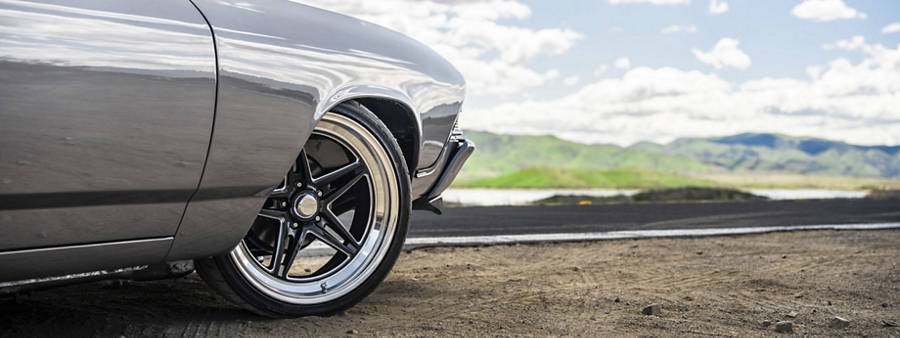
Aftermarket wheels are replacement wheels made by companies other than your vehicle’s original manufacturer (OEM). They offer more choices in style, size, construction, and performance than factory wheels. In many instances, they are much less expensive than OE wheels, making them a popular upgrade for drivers who need to replace their damaged OE wheels. They also offer appealing customization in appearance, capability, and performance for wheel upgrades. Choosing the right aftermarket wheels is easy when you determine the right fit, wheel type, and finish for you and your vehicle.
SHOP ALL WHEELSWHAT ARE AFTERMARKET WHEELS?
Aftermarket wheels are produced by third-party manufacturers and not your vehicle’s original manufacturer (OEM). Original equipment (OE) wheels come with your vehicle from the factory. Some aftermarket wheels are produced in the same factory as OEM wheels. Aftermarket rims offer another option for drivers who want or need to replace their wheels.
OEM vs Aftermarket Wheels
Quick Answer:
In general, Original Equipment (OE) wheels offer a dependable wheel replacement option because you know it will fit and is suitable for your vehicle’s specifications. Aftermarket wheels, on the other hand, offer a larger range of customization, designs, finishes, and price points. They do require careful attention to wheel and vehicle specifications to ensure they fit.
| OE vs Aftermarket Wheels | ||
|---|---|---|
| Category | OE (Original Equipment) Wheels | Aftermarket Wheels |
| Purpose | Designed by the vehicle manufacturer for broad customer appeal. | Designed to give customers more choices in style, performance, cost, and fitment. |
| Fitment | Built specifically for the vehicle as it left the factory. | Available in vehicle-specific fitments and engineered to meet vehicle requirements when properly selected. |
| Style Options | Limited to the designs offered by the manufacturer. | Thousands of styles, finishes, sizes, and designs available. |
| Personalization | Maintains the intended factory appearance. | Allows customers to create a unique look that reflects their personality. |
| Sizing Choices | Typically limited to factory sizes. | Multiple sizing options can enhance appearance and accommodate customer preferences. |
| Performance Potential | Designed to meet factory performance standards. | Some wheels are engineered to reduce weight, improve handling response, or support off-road use. |
| Cost | OE replacement wheels are often more expensive because they are sourced through the manufacturer or dealership. | In most cases, aftermarket wheels offer a lower-cost alternative with a wider range of price points and styles. |
| Availability | May require ordering through the manufacturer. | Large selection available through specialty retailers. |
| Technology & Materials | Uses materials selected by the manufacturer. | Available in cast, flow-formed, and forged constructions depending on performance goals. |
WHY UPGRADE TO AFTERMARKET WHEELS?
Drivers choose to upgrade to aftermarket wheels for a number of reasons, including:
- Wide range of price points
Aftermarket wheels can be cheaper or more expensive than OEM options, depending on the style, construction, material, and manufacturer. - Plentiful design and finish options
- Customization
- Specific driving need
These may include motorsports, rally racing, off-roading, towing, and more. - Great range of sizes and fitments
OE wheels are often limited to a short list of available sizes that are tied to specific vehicle trims, model years, and packages. Aftermarket wheels give you more potential flexibility to change your wheel size.
| Aftermarket Wheel Myth vs Fact | |
|---|---|
| Myth | Fact |
| Aftermarket wheels are only for car enthusiasts. | Many everyday drivers buy aftermarket wheels for appearance, replacement cost, or personalization. |
| Aftermarket wheels will not fit my vehicle correctly. | Professional retailers use vehicle-specific fitment data to ensure compatibility. |
| Bigger wheels always mean a rough ride. | The right wheel and tire package can preserve ride quality while enhancing appearance. |
| Aftermarket wheels are less safe than factory wheels. | Reputable aftermarket wheels are engineered and tested for real-world use. |
| Upgrading wheels is complicated. | Our experts can guide customers through our easy process. |
Are Aftermarket Wheels Worth It?
Aftermarket wheels can be worth it if you find ones that meet:
- Your vehicle’s specifications
- Your budget
- Your driving needs
- Your aesthetic preferences
It’s entirely possible to find an aftermarket wheel that you like, that fits your budget, and your vehicle needs for less than an original equipment option.
BEFORE YOU BUY: AFTERMARKET WHEEL CHECKLIST
Discount Tire can help you find the correct wheel size, ensure proper fitment, find the best wheel for you, and professionally install and maintain your new wheels!
SCHEDULE AN APPOINTMENTIf you prefer to shop on your own, the list below can help you feel confident in your choice
- Verify your vehicle’s bolt pattern
- Choose the correct wheel diameter and width
- Confirm offset and center bore
- Ensure brake and suspension clearance
- Select wheels that match your driving needs
- Choose compatible tires
- Schedule professional installation
HOW TO CHOOSE THE RIGHT AFTERMARKET WHEELS
Quick Answer:
Choosing the right aftermarket wheel starts with proper fitment. Discount Tire’s online shopping tools let you shop by vehicle, narrowing your options to wheels designed to fit. Next, consider load rating, construction, intended use, and of course design and finish (that’s the fun part!).
SHOP WHEELS BY VEHICLEThere are a number of factors to consider when shopping for an aftermarket wheel.
- Start With Size And Fitment
Your new wheel must be compatible with your vehicle or it will not fit or perform safely. Pay attention to:- Wheel diameter
- Wheel width
- Bolt pattern
- Offset
- Center bore
We can help you find your size. Just add your vehicle to find products that fit.
ADD MY VEHICLE TO FIND MY SIZEIf you know your wheel size, you can shop by wheel size on our website:
SHOP BY WHEEL SIZE - Consider Wheel Construction
Wheels are constructed with a variety of manufacturing processes, which affects your wheel’s strength, weight, durability, and price. - Match The Wheel To Your Driving Needs
The right wheel for you will depend on how you use your vehicle. A daily commuter will require different wheels than a heavy-duty truck that regularly tows, for example. If you need:- Daily driving: prioritize durability, value, efficiency, and easy maintenance
- Performance driving: prioritize lightweight wheels that improve handling and responsiveness
- Off-road: prioritize wheels that can withstand impacts and heavy loads
- Winter: prioritize moisture and chemical resistance; dedicated winter wheels protect your regular wheels and support a seasonal tire switch
- Pay Attention To Wheel Weight
Wheel weight can have a noticeable impact on vehicle performance. Lighter wheels can help improve acceleration, braking, handling, and overall driving feel. It also can affect your fuel efficiency. - Choose A Style and Finish You Love
Lastly, focus on the wheel’s appearance. Aftermarket wheels are available in countless styles, including:You can shop by style on our website!
SHOP BY STYLE
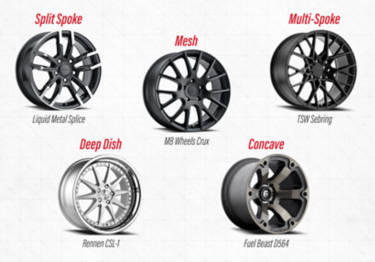
There is also a rainbow of finishes available, including:
Check out our wheel visualizer
WHEEL VISUALIZERA particular wheel style might catch your eye but remember it must fit your vehicle and driving needs. Let us help you find the right combination of style and function!
Discount Tire carries the largest selection of aftermarket and OEM replica wheels in the United States, giving you the flexibility to get the look, performance, and price you want for your next wheel upgrade or replacement. Visit us in-store or start shopping now online.
WHEEL CONSTRUCTION EXPLAINED
Wheels are made with a variety of construction types and materials. You should pick one that meets or exceeds your vehicle’s requirements so you see the performance you need.
| Types of Wheel Construction | |
|---|---|
| Type | Explanation |
| Cast | Formed by pouring molten metal into a mold. There are several types of casting. |
| Gravity casting | Gravity casting: simple, cost-effective method using gravity to create force to fill the mold. Wheels may be dense to achieve the same strength of lighter wheels. |
| Low-pressure casting | Low-pressure casting: Low air pressure rapidly pumps wheel mold full of molten aluminum to yield a strong and inexpensive product with few imperfections. |
| High-pressure casting | High-pressure casting: High air pressure pumps molten aluminum into mold for a strong, dense final product. |
| Forged | Sometimes called billet wheels. Formed by using a solid billet of aluminum shaped under extreme heat and pressure. They create maximum density and lightest weight. |
| Flow-formed | Also called rim-rolled wheels. Formed with low pressure casting while spun on a specialized machine, yielding a strong, lightweight wheel that is typically less expensive than forged wheels. |
Wheels also come in different construction designs depending on their parts: one-piece, two-piece, and multi-piece.
| Feature | One-piece | Two or Multi-piece |
|---|---|---|
| Explanation | Also called monoblock. The wheel is formed in one solid piece. | The rim and center sections are formed separately and then attached with bolts or welding. |
| Pros |
|
|
| Cons |
|
|
*Multi-piece wheels use specialized silicone seals to bond the wheel, but over time seals can degrade and fail, leading to an air leak
Most modern wheels use steel or aluminum (a common component in alloy wheels).
| Feature | Steel | Aluminum/Alloy |
|---|---|---|
| Weight | Heavier | Lighter |
| Strength | High | Moderate |
| Efficiency | Less efficient | More efficient |
| Construction Design | Two-piece | Single or multi-piece |
| Cost | Less expensive | More expensive, typically |
| Appearance | Typically basic designs | Wide range of styles and finishes |
WHEEL SIZE & FITMENT: QUICK BASIC OVERVIEW
Wheel size is composed of several different measurements: diameter, width, bolt pattern, and offset. Here is an example wheel size:
16x7 4-100 40
This string of numbers gives you all the info you need to know. Here’s what they mean:
Wheel diameter: 16’’
Wheel width: 7’’
Wheel bolt pattern: 4-100 (4 lug holes around a 100mm circle)
Wheel offset: +40mm (mounting surface is 40mm away from the wheel’s centerline)
Fitment (sometimes called wheel fitment or tire fitment) refers to the process of matching tires and wheels to your vehicle’s exact specifications. This ensures proper performance, safety, and handling.
Learn more at our Wheel Size and Fitment Guide!
Discount Tire can help find your correct wheel size for your vehicle. Just ask!
FIND MY STOREWHEEL STYLES & 2026 TRENDS: QUICK LOOK
Wheel styles are always changing. Want to stay current on modern trends? Check out our quick look for 2026.
| 2026 Wheel Trends | |
|---|---|
| Styles |
|
| Finishes |
|
| Construction |
|
| Related accessories |
|
For a more thorough look at current wheel trends, check out our Wheel Design Trends blog!
BEST AFTERMARKET WHEELS BY VEHICLE TYPE
The best wheel for you depends on your vehicle’s specifications and your needs. All aftermarket wheels need to:
- Match your vehicle’s size specifications
- Have the appropriate load rating
- Be compatible with your tires
- Offer adequate clearance for components like brakes and suspension
However, broad vehicle types tend to have similar performance and construction needs.
Here’s what matters most:
Passenger car
Common priorities:
- Everyday drivability
- Easy maintenance
- Lightweight construction
- Timeless styling
Many passenger car owners prioritize functionality, efficiency, and comfort. Aesthetics may be a higher priority for some drivers, especially those with performance/sports vehicles. Depending on the wheel and vehicle, lightweight wheels may help preserve responsive handling and fuel efficiency.
Crossover
Common priorities:
- Adequate load rating
- Correct fitment
- Balance of weight and durability
- Versatility
Crossover owners should prioritize correct fitment to avoid rubbing or clearance issues that could compromise the vehicle’s performance or safety. Also consider balancing weight and durability to ensure your vehicle can support its typical payload (passengers or frequent cargo) plus its curb weight.
CHECK OUT THE BEST CUV TIRESSUV
Common priorities:
- Large wheel diameters
- Luxe or off-road styling
- Weight support and strength
The best wheels for your SUV heavily depends on how you use it, but all will require larger rim sizes and appropriate load ratings. Off-road centric wheels need to be strong and damage resistant. Luxurious family vehicles or commuters trend towards higher-end designs.
Pickup truck
Common priorities:
- Load requirements
- Rugged styling and capability
- Larger diameters
- Tire compatibility
Load requirements and tire compatibility are even more important in large powerful vehicles like pickup trucks, regardless if they’re used for work or commute. Pickup truck owners should look for wheels that suit their intended use. Pickup owners wanting to reduce unsprung weight should focus on aluminum alloy wheels rather than steel.
EV
Common priorities:
- EV tire compatibility
- Load requirements
- Aerodynamic styling
- Vehicle fitment
Electric vehicles are heavier than their gas-powered counterparts due to battery weight, so load requirements are an important feature to keep in mind. EV owners also should prioritize EV tire compatibility and vehicle fitment to ensure a seamless drive experience. Many OEM wheels for electric vehicles tend to have aero-capped or solid wheel faces to smoothly channel air and reduce resistance.
HOW MUCH DO AFTERMARKET WHEELS COST?
Quick Answer: On average, a set of four aftermarket wheels can cost between $600 and $2,000 for passenger vehicles and trucks. This depends largely on construction type, size, material, and brand.
When it comes to wheel prices, the sky is the limit. Cost principally depends on construction method, material, size, and even style. Check out our cost breakdown by category below.
| Average Cost of Aftermarket Wheels (By Category) | ||
|---|---|---|
| Category | Average Cost | Notes |
| Cast (Entry-level) | $125-250/wheel | Frequently made of aluminum alloy for lightweight strength |
| Flow-formed (Mid-level) | $300-$550/wheel | Similar to forged but less dense and less expensive. |
| Forged (Premium level) | $600-$1,500+/wheel | Maximum strength and lightest weight |
Hidden Wheel Costs
Keep in mind when purchasing a new set of aftermarket rims that there are additional costs beyond the rims themselves. These include:
Mounting & balancing: Typical tire shops expect $80-$150 to mount and balance your tires. Discount Tire only has one installation fee, after which your rotation and balancing is FREE.
DISCOUNT TIRE FREE ROTATION & BALANCINGNew tires: If you alter the size of your wheels from OE specifications, you may need new tires to fit your new rims.
Discount Tire offers wheel and tire packages for one-stop shopping and installation! We also offer deals, promotions, price matching, and our low price guarantee 365 days a year.
INSTALLATION, CARE, & SAFETY
You’ve bought your dream wheels, but now what? Proper installation, maintenance, and safety should come next.
1. Professional Installation Matters
Professional installation helps ensure your wheels are installed correctly, balanced properly, and fit your vehicle as intended. It also helps reduce the risk of vibrations, uneven tire wear, and other fitment-related issues.
A professional installer can:
- Verify proper wheel fitment
- Install compatible TPMS sensors
- Balance the wheel and tire assembly
- Inspect lug hardware
- Check center bore compatibility
- Confirm brake and suspension clearance
2. Wheel Component Check-Ups
Many wheel manufacturers recommend checking lug nut torque after the first 50 to 100 miles of driving after installation. This makes sure the wheel remains properly secured as the components settle.
Always follow your vehicle and wheel manufacturer’s recommendations rather than using a generic torque value.
3. Maintenance (It’s More Than Cleaning)
Regular maintenance of your wheels helps:
- Protect your wheel’s finish
- Catch minor damage before it gets worse
- Ensures your tires wear evenly
- Improve ride quality
- Protects your investment
Basic wheel maintenance includes:
- Getting a wheel alignment once a year (or sooner if you notice vibration, uneven wear, pulling, or you experience damage)
- Balancing your tires and wheels every 6,000-miles
- Regularly cleaning your wheels:
- …and follow any care instructions specific to your wheel’s finish
- …with mild soap and water (avoid harsh or abrasive cleaners unless approved by wheel manufacturer)
- …to remove brake dust and road grime
- …to remove road salt and other winter contaminants
- …and repairing chips and scratches promptly
- …and inspecting your wheels for curb damage, bends, or cracks
- …and checking tire pressure regularly, especially after temp changes
Make sure to review your wheel’s warranty information for both finish and defects in materials or workmanship. Ensure you’re doing nothing to compromise your warranty’s coverage.
FAQ
Aftermarket wheels are produced by third party manufacturers and not your vehicle’s original manufacturer (OEM), although sometimes they are produced in the same factory. Aftermarket wheels offer another option for drivers who want or need to replace their wheels.
Not necessarily. It depends on your needs and wants. OEM wheels are guaranteed to fit and are tailored for your vehicle’s requirements. Aftermarket wheels offer more flexibility with style, finish, and size but require careful sizing to ensure good fit. Aftermarket rims can often be less expensive than OEM wheels, but not always.
Discount Tire can help you find wheels that fit your vehicle, free of charge. You can also input your vehicle details on our website and shop by wheels that fit. If you prefer to shop solo, match the following to your existing wheels or vehicle specifications: bolt pattern, wheel diameter and width, offset, center bore, and brake and suspension clearance.
Cast wheels are formed by pouring molten metal into a mold. It is typically the most affordable option. Flow-formed uses low-pressure casting in a specialized spinning machine to create a strong but lightweight wheel. It is typically less expensive than forged wheels. Forged wheels are formed by a solid billet of aluminum shaped under extreme heat and pressure, offering maximum density and lightest weight.
Yes, bigger wheels can affect your ride quality. Larger wheels typically deliver a harsher, firm ride because they require lower profile tires that cannot cushion as effectively against impacts as regular tires. However, they do offer sharper, more immediate steering responses and better grip during aggressive cornering and driving. However, with the right combination of size and tire choice, you can mitigate these concerns.
All wheels can affect fuel economy to some degree. However, you will see negative effects to your fuel range (both gas and electric vehicles) when you upgrade to a larger size, heavier wheels, or adjust your wheel offset because these factors affect rolling resistance and drag.
Quality aftermarket wheels that fit and are installed properly on your vehicle can be a safe replacement for factory wheels. Not all aftermarket options are built to the same standards. Make sure to purchase wheels from reputable manufacturers and check if the wheel has earned certifications from major associations, such as JWL (Japan Light Alloy Wheel), VIA (Vehicle Inspection Association), SAE J2530 (Society of Automotive Engineers, United States), or TÜV (Technischer Überwachungsverein, globally recognized German technical testing group).
No, aftermarket wheels do not automatically void your entire vehicle warranty. Coverage can only be voided if the vehicle manufacturer or dealer can prove that your new wheels directly caused a failure.
An average set of aftermarket wheels can cost between $600 to $2,000 for both passenger vehicles and trucks. This depends largely upon construction type, size, material, and brand.
You can, but we do not recommend it. Most people do not have the proper equipment to check for proper fit, balance, and TPMS compatibility. A professional installation ensures your wheels are installed correctly, balanced, and fit your vehicle as intended.
Ready to roll?
If you have any questions or are unsure what wheels work best for you, drop in or give us a ring. We’ll get you taken care of. Buy and book online and save time in-store!
Stay up to date with Discount Tire content: add us as a Preferred Source in Google Search.
For more information on this and other tire and wheel services, check out ourYouTube Channel or reach out to us on X, Instagram, Facebook, TikTok and LinkedIn.