
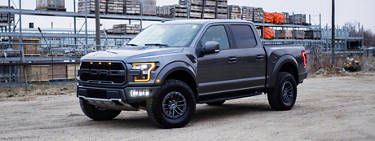
Truck tire load ratings indicate how much weight a tire can carry when properly inflated. In addition, load range indicates how strong a tire is. Passenger tires (P-metric) typically use Standard Load (SL) or Extra Load (XL) while Light Truck (LT) tires typically use higher load ratings such as C, D, E, and F. Both measures are found on your tire’s sidewall. Choosing the correct tire load rating and range helps ensure your truck can safely support its weight, cargo, and towing demands while meeting the vehicle manufacturer’s requirements.
WHAT IS TRUCK TIRE LOAD RATING?
Load rating, or load index, is a numerical code found on your tire’s sidewall that indicates how much weight it can safely support when properly inflated.
Load rating and load index are the same measurement.
You can find your load index on your tire’s sidewall and in your vehicle owner’s manual.
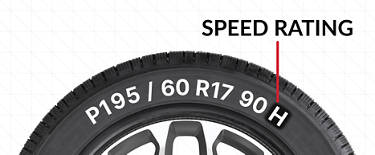
Drivers of large vehicles like trucks should pay attention to their load rating/index to ensure they are not overloading their tires with their truck or cargo’s weight. Most cars and light trucks have load indexes ranging from 70-124 (739 to 3,527 lbs).
LOAD INDEX VS LOAD RANGE
Load index and load range both describe a tire’s ability to hold air pressure and carry weight, but they each focus on separate functions. You need to know both to safely operate your truck.
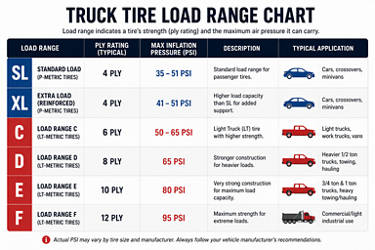
Load range describes a tire’s toughness and max air pressure. It’s represented by a letter or set of letters to indicate a ply rating (toughness) and max load carrying pressure. It is based on an older tire measurement called ply rating.
Load index explicitly indicates the maximum load a tire can carry. It is represented by a number that corresponds to a carrying capacity in pounds. View our full load index chart at the link below.
LOAD INDEX VS LOAD RANGEWHAT DO SL, XL, C, D, E, AND F MEAN?
Letters like SL, XL, C, D, E, and F refer to your tire’s load range, which is a measurement of a tire’s toughness and maximum air pressure. It follows your tire’s size on your sidewall.
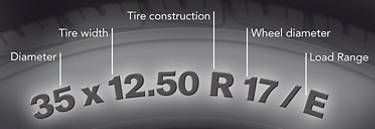
Smaller vehicles, such as sedans, crossovers, and minivans, do not typically include the load range measurement because they have a standard 4-ply rating. They don’t require higher load carrying capabilities. However, they might include SL (Standard Load) or XL (Extra Load or Reinforced) for additional load support.
WHY TRUCK TIRES HAVE DIFFERENT LOAD RATINGS THAN PASSENGER TIRES
Trucks are engineered to handle significantly higher cargo weight, towing force, and frequent payload shifts. Passenger vehicle tires focus on ride comfort and efficiency, but truck tires must be able to handle heavy-duty use.
Truck tires are commonly available in C, D, and E load ranges. E (10-ply) tires are required on three-quarter and one-ton trucks.
ABOUT 10-PLY TIRESTires rated F and higher are typically for commercial or heavy-duty vehicles. You can equip your light truck with an F-rated tire, but you will experience a harsh ride.
HOW TO CHOOSE THE RIGHT LOAD RANGE FOR YOUR TRUCK
The right truck load range depends on how your truck is equipped and how you use it. The following factors all play a role:
- Payload
- Towing
- Tire size
- Vehicle manufacturer’s specifications
Before you buy new tires, check your driver’s side door placard or owner’s manual for vehicle manufacturer specifications. It should list the minimum tire size, load index, and inflation pressure needed to safely support your truck’s Gross Vehicle Weight Rating (GVWR).
Quick Guide: Which Load Range Fits Your Driving?
The best choice for trucks primarily used for commuting or everyday driving are replacement tires that meet your vehicle manufacturer’s specifications. Trucks that carry heavy cargo or tow will benefit from an LT tire with a higher load range, provided it is approved for your vehicle and sized correctly.
*Always choose tires that meet or exceed your vehicle manufacturer’s required load capacity and are approved for your truck’s size.
Higher load ranges aren’t automatically better. Tires with a higher load carrying capacity than your truck requires can result in a harsher ride that is uncomfortable for everyday driving.
Load Range Is Only Part of the Picture
Remember that load range and load index work together. Two tires with the same load range but different sizes may have different load indexes and max load capacities.
Match the appropriate tire size with replacement tires with a load index that meets or exceeds your vehicle manufacturer’s recommendations.
TOWING CONSIDERATIONS
Your truck’s tires play an important role in safely supporting the combined weight of your vehicle, passengers, cargo, and trailer tongue weight.
Before towing:
- Verify your truck is equipped with the proper tires
Your tires should be able to handle the carrying capacity of your load and still meet your vehicle’s specifications. - Perform a safety check on both truck and trailer tires
Look for damage, low tire pressure, and uneven treadwear. Address these issues before towing. - Inflate to the recommended air pressure
Underinflated tires generate excess heat, which can reduce load carrying capacity, increase tire wear, and create the risk of tire damage.
Remember: truck and trailer tires serve different purposes. Truck tires are designed to handle the demands of your truck (traction, weight, power delivery, etc). Trailer tires are designed to handle the demands of your trailer and payload. They are not interchangeable, but both should be properly maintained.
If you’re ever unsure, our tire experts at Discount Tire can help you choose the tires that match your vehicle and intended use.
FIND MY STORECOMMON MISTAKES
Here are some common truck tire load rating mistakes some drivers make:
Choosing tires based only on load range
Load range is only one part of the equation. Tire size, load index, and vehicle manufacturer specifications are all equally important when selecting replacement tires.
Assuming 10-ply means the tire has 10 plies
Modern tires no longer use ply count to describe strength. Although you’ll still see terms like “10-ply,” today’s load range designations indicate a tire’s load carrying capability and not the number of physical plies used in construction.
Assuming higher load range is always better
Higher load range tires have stronger construction and can support more weight when properly inflated, but they also provide a firmer ride than tires designed for light-duty applications. If you don’t haul or tow heavy loads regularly, your vehicle manufacturer’s recommended tire may provide the best balance of ride comfort and performance.
Ignoring tire air pressure
Tires cannot safely perform as intended if they’re not properly inflated, even if they’re the correct load rating. Check your tire pressure regularly and follow the inflation recommendations listed on your driver’s side door placard or in your owner’s manual. Do not inflate your tires to the listed air pressure on your tire’s sidewall; this is the tire’s maximum tire pressure and may be an unsafe level for your needs.
FAQ
Letters like SL, XL, C, D, E, and F identify a tire’s load range. They indicate how tough your tire is and how much air pressure it can hold. Passenger vehicle tires commonly use Standard Load (SL) or Extra Load (XL) ratings while Light Truck (LT) tires typically use higher load ranges such as C, D, E, and F.
Not exactly. “10-ply” is an older term that refers to a tire’s strength rating when it corresponded to the number of plies used in its construction. Modern load range E tires are designed to provide a comparable load carrying capability to older 10-ply tires, but they do not necessarily contain 10 plies.
Load range D and E differ in strength and max load carrying air pressure. Load range D has an 8-ply rating strength and max psi of 65-50 psi (depending on whether it is D1 or D2). Load range E has a 10-ply rating strength and max psi of 65-80 psi (depending on whether it is E1 or E2).
Possibly. The right tire depends on your truck’s manufacturer’s specifications and how you use it. If you regularly tow or haul heavy loads, you may require higher-capacity LT tires. Always choose tires that meet or exceed your vehicle’s required load capacity.
You can, but because they are designed for three-quarter and one-ton trucks, you will probably experience a harsher ride.
Not necessarily. A higher load rating doesn’t automatically improve safety or performance for every truck. The best approach is to match your vehicle manufacturer’s specifications and your driving needs.
Ready to roll?
If you have any questions or are unsure what tires work best for you, drop in or give us a ring. We’ll get you taken care of. Buy and book online and save time in-store!
Stay up to date with Discount Tire content: add us as a Preferred Source in Google Search.
For more information on this and other tire and wheel services, check out ourYouTube Channel or reach out to us on X, Instagram, Facebook, TikTok and LinkedIn.